The Four Pillars of P4 Medicine
A revolutionary framework that shifts healthcare from reactive treatment to proactive, data-driven wellness — using deep biological data to maintain health rather than merely manage disease.
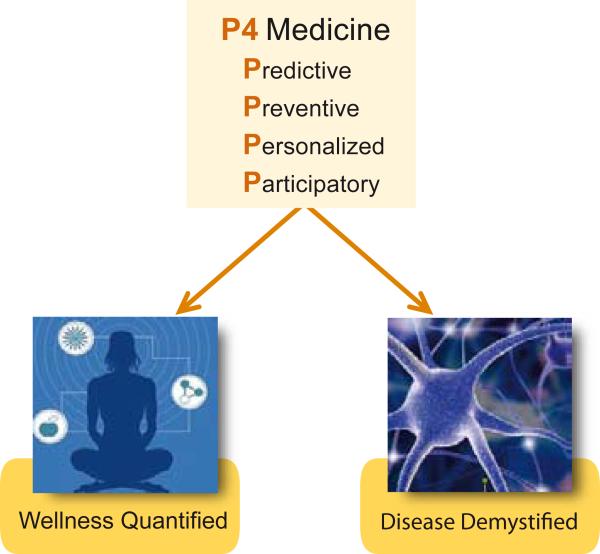
P4 Medicine was pioneered by systems biologist Dr. Leroy Hood and represents a fundamental reimagining of healthcare — from a system that reacts to illness to one that proactively maintains wellness through continuous biological monitoring and personalized intervention.
The Dual Outcome
Wellness Quantified. Disease Demystified.
P4 Medicine produces two transformative outcomes: it quantifies wellness — giving individuals a precise, data-driven picture of their optimal biological state — and it demystifies disease, revealing the molecular mechanisms that drive illness long before symptoms appear.
Together, these outcomes shift the entire healthcare paradigm: from managing sickness to optimizing health, from population averages to individual precision.
Predictive
Forecasting health risks before they become reality
Predictive medicine harnesses the power of genomic sequencing, multi-omics profiling, and machine learning to calculate an individual's risk for specific diseases — often decades before any clinical sign appears. Rather than waiting for a diagnosis, predictive medicine gives you a biological forecast of your future health, enabling proactive decisions today.
Key Impact
Predictive medicine transforms the timeline of healthcare — shifting the critical intervention window from "after diagnosis" to "years before symptoms," when prevention is most effective and least costly.
Real-World Applications
- Identifying BRCA1/2 carriers for preventive breast and ovarian cancer screening
- Calculating cardiovascular polygenic risk scores to guide statin therapy decisions
- Predicting Type 2 diabetes onset 10+ years before clinical diagnosis
- Forecasting Alzheimer's risk using APOE genotyping and amyloid biomarkers
- Anticipating pharmacogenomic drug responses before prescribing
How It Works
Polygenic Risk Scoring
Thousands of genetic variants are aggregated into a single risk score that quantifies your lifetime probability of developing conditions like heart disease, cancer, or diabetes.
Genomic Sequencing
Whole-genome or whole-exome sequencing identifies rare high-impact variants — such as BRCA1/2 mutations for breast cancer — that confer dramatically elevated disease risk.
Multi-Omics Integration
Combining genomic, proteomic, metabolomic, and epigenomic data creates a multi-dimensional risk portrait far more accurate than any single data layer alone.
AI Pattern Recognition
Machine learning models trained on population-scale biological datasets identify subtle molecular signatures that precede disease onset by years or decades.
Preventive
Catching and reversing disease transitions early
Preventive precision medicine goes beyond traditional prevention by identifying the earliest molecular transitions from wellness to disease — and deploying targeted interventions to reverse them. This is not generic lifestyle advice; it is biologically-informed, individually-tailored prevention based on your unique risk profile and current biological state.
Key Impact
By catching disease at the molecular transition stage — before it becomes clinically established — preventive precision medicine can reverse conditions that would otherwise progress to chronic disease, dramatically reducing suffering and healthcare costs.
Real-World Applications
- Reversing pre-diabetes through precision nutrition and exercise protocols
- Detecting and treating pre-hypertension before cardiovascular damage occurs
- Identifying and correcting early metabolic syndrome markers
- Monitoring cancer survivors for molecular recurrence signals
- Intervening in early neuroinflammation before cognitive decline manifests
How It Works
Longitudinal Biomarker Monitoring
Regular measurement of circulating biomarkers — inflammatory markers, metabolic panels, hormonal profiles — tracks subtle deviations from your personal baseline before they become clinically significant.
Liquid Biopsy Surveillance
Cell-free DNA and circulating tumor cells in blood samples enable non-invasive cancer surveillance, detecting early malignant transitions years before imaging can identify a tumor.
Microbiome Analysis
The gut microbiome plays a critical role in metabolic, immune, and neurological health. Dysbiosis patterns are early indicators of inflammatory and metabolic disease transitions.
Epigenetic Clocks
DNA methylation patterns reveal biological age versus chronological age — identifying accelerated aging trajectories that predict disease risk and respond to targeted interventions.
Personalized
Tailored to your unique biological blueprint
Personalized medicine replaces the population-average approach with interventions precisely calibrated to your individual biology. Your genome, microbiome, metabolome, and lifestyle data combine to create a health strategy that is uniquely yours — from the foods that optimize your metabolism to the medications that will work best for your genetic profile.
Key Impact
Personalized medicine eliminates the inefficiency and harm of one-size-fits-all treatment. When interventions are matched to individual biology, efficacy improves dramatically, side effects decrease, and healthcare resources are deployed where they will have the greatest impact.
Real-World Applications
- Matching cancer patients to targeted therapies based on tumor genomic profiling
- Optimizing antidepressant selection using CYP450 pharmacogenomic testing
- Designing individualized nutrition plans based on glycemic response data
- Tailoring cardiovascular medication dosing to genetic metabolizer status
- Personalizing microbiome-targeted interventions for inflammatory conditions
How It Works
Pharmacogenomics
Your genetic variants determine how you metabolize medications — whether a drug will be effective, ineffective, or potentially harmful. Pharmacogenomic testing eliminates dangerous trial-and-error prescribing.
Precision Nutrition
Continuous glucose monitoring combined with microbiome analysis reveals how your body uniquely responds to different foods — enabling a dietary plan optimized for your specific metabolic profile.
Exercise Genomics
Genetic variants in muscle fiber composition, VO2 max potential, and recovery capacity inform exercise prescriptions tailored to maximize your individual fitness response.
Targeted Therapeutics
Cancer treatments matched to the specific molecular mutations driving a tumor — rather than the organ of origin — achieve dramatically higher response rates with fewer side effects.
Participatory
Empowering you as an active partner in your health
Participatory medicine transforms the patient from a passive recipient of care into an informed, engaged partner in their own health management. Through continuous data collection, transparent communication, and shared decision-making, individuals gain unprecedented insight into their biology — and the agency to act on it.
Key Impact
When individuals are active participants in their health — not passive patients — adherence improves, outcomes improve, and the relationship between person and provider becomes a genuine partnership. Participatory medicine is the foundation of a sustainable, proactive healthcare system.
Real-World Applications
- Using continuous glucose monitoring to understand personal metabolic responses
- Participating in genomic research cohorts to advance precision medicine science
- Engaging with digital health platforms for personalized wellness coaching
- Sharing wearable data with physicians for more informed clinical decisions
- Accessing and understanding personal genomic risk reports
How It Works
Wearable & Continuous Monitoring
Smartwatches, continuous glucose monitors, and biosensors generate a real-time stream of physiological data — heart rate variability, sleep architecture, activity patterns — that individuals can track and share with their care team.
Personal Health Records & Data Ownership
Individuals own and control their biological data, enabling seamless sharing across providers, research participation, and longitudinal health tracking across their lifetime.
Shared Decision-Making
Precision health tools translate complex genomic and biomarker data into understandable insights, enabling patients to make genuinely informed decisions about screening, prevention, and treatment.
Citizen Science & Research Participation
Participatory models enable individuals to contribute their biological data to population-scale research, accelerating discovery while benefiting from the collective knowledge generated.
The Biological Data Stack
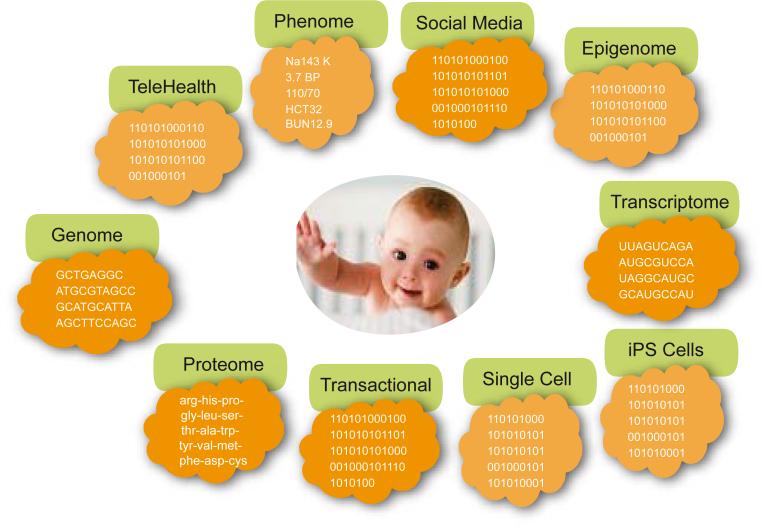
The Data Layers Powering P4 Medicine
P4 Medicine integrates multiple layers of biological information — from your DNA to your real-time metabolic state — to build an unprecedented, dynamic picture of your individual health.
Genomics
Your complete DNA sequence — 3 billion base pairs encoding your predispositions, drug responses, and biological capabilities. The foundation of precision medicine.
Proteomics
The full complement of proteins expressed by your cells at any given moment — revealing active biological processes, disease markers, and treatment targets.
Metabolomics
Small molecule metabolites in blood, urine, and tissue that reflect your metabolic state in real time — a dynamic readout of how your biology is functioning right now.
Phenomics
The measurable physical and biochemical traits that emerge from the interaction of your genome and environment — bridging genetic potential and lived biological reality.
Epigenomics
Chemical modifications to DNA and histones that regulate gene expression — revealing how environment and lifestyle are shaping your biology at the molecular level.
Microbiomics
The trillions of microorganisms inhabiting your gut, skin, and airways — profoundly influencing immune function, metabolism, mood, and disease susceptibility.
Digital Phenotyping
Continuous data streams from wearables and sensors — heart rate variability, sleep stages, activity patterns, glucose dynamics — capturing your physiological state in real time.
Exposomics
The totality of environmental exposures across your lifetime — air quality, diet, stress, toxins — and their cumulative biological impact on your health trajectory.
The Future of Health
Shifting Focus from Treating Disease to Maintaining Wellness
The P4 framework is not a distant vision — it is an emerging reality, powered by exponential advances in genomic sequencing, biosensor technology, and artificial intelligence. The question is not whether precision medicine will transform healthcare, but how soon you will benefit from it.